What Is a One-Person Company? How AI Agents Are Transforming Small Businesses
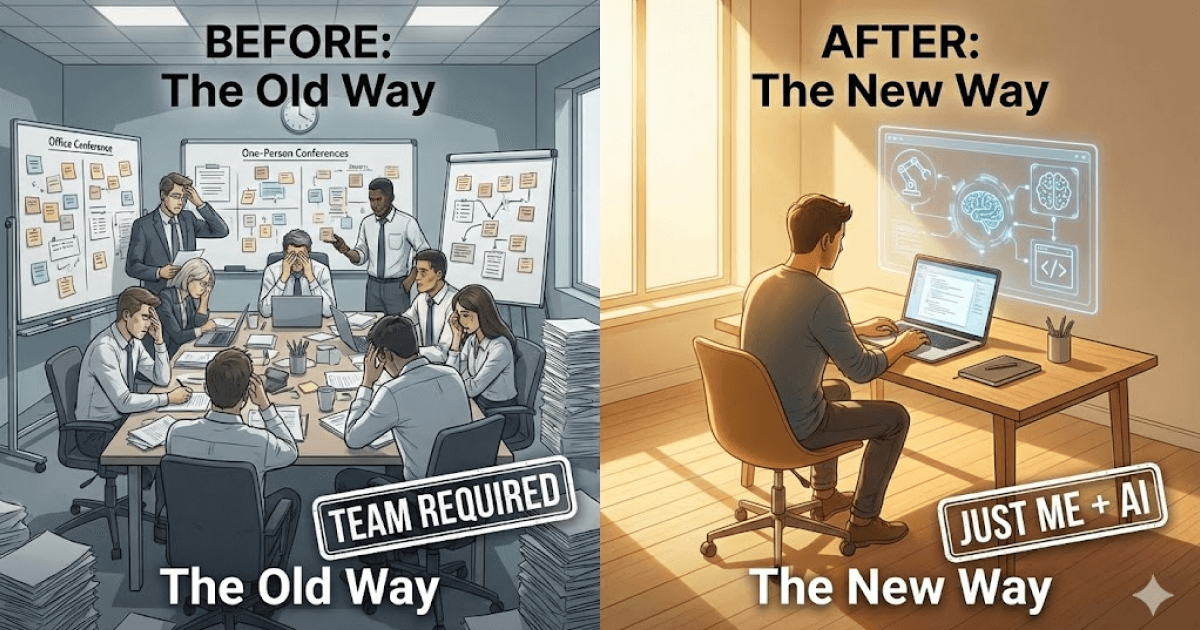
I didnt plan to build a one person company it just happenedI Didn’t Plan to Build a One-Person Company. It Just Happened.
If you told me a few years ago that I’d be running a real product, serving users, shipping features, fixing bugs, handling payments, and doing support — mostly alone — I wouldn’t have believed you.
Not because I lacked ambition.
Because that used to require a team.
Today, it doesn’t.
Not because I work 20 hours a day. Not because I’m some genius. Because the way companies operate has quietly changed.
AI tools and agents now handle work that used to require entire departments.

I started like most builders doI Started Like Most Builders Do
Build something useful. Ship it. See what happens.
At first, you think you’ll eventually “hire properly” once things grow.
Designer later. Marketing later. Support later.
But something strange happens.
You don’t actually need to.
You find tools that cover gaps. You automate repetitive work. You build internal scripts. You reuse components. You simplify decisions because there’s no committee to satisfy.
Instead of building a team, you build systems.
My team became softwareMy “Team” Became Software
On paper, it looks like a one-person operation.
In practice, there are many moving parts running all the time:
Servers deploying updates Systems sending emails Workflows processing data Dashboards monitoring health Agents handling routine tasks Scripts cleaning things up at 3 AM
Customers don’t see one person. They see a functioning product.
And that’s what matters.
Ai agents changed the nature of workAI Agents Changed the Nature of Work
Earlier tools required constant input. You had to drive everything manually.
Now you can describe outcomes and let processes run.
Need to improve something? Analyze usage, identify weak points, generate options, test changes.
Need content or documentation? Drafts appear instantly, then you refine.
Need repetitive tasks done? Set rules once, let them run forever.
You stop doing mechanical work and spend more time deciding what actually matters.
The biggest shift no waitingThe Biggest Shift: No Waiting
No waiting for designers. No waiting for approvals. No waiting for another team’s sprint.
If a user reports a problem, it can be fixed immediately.
If an idea seems promising, it can be shipped the same day.
Speed compounds in ways people underestimate.
Many larger companies aren’t losing because they lack talent. They’re losing because they can’t move.
The money side is wildly differentThe Money Side Is Wildly Different
There’s no payroll anxiety.
Costs are mostly predictable:
Hosting Tools APIs Infrastructure Payment fees
If revenue grows, margins grow with it.
You don’t need explosive growth to survive. You just need consistency.
That changes your decision-making. You can focus on stability instead of chasing vanity metrics.
But its not effortlessBut It’s Not Effortless
Being solo removes friction, but also removes support.
Every decision is yours. Every mistake is yours. Every outage is yours.
There’s no one to “hand things off” to when you’re tired.
And there’s a quiet kind of pressure knowing that if you stop pushing forward, nothing moves.
It’s freedom, but it’s also responsibility in its purest form.
Loneliness is real but manageableLoneliness Is Real (But Manageable)
Not dramatic loneliness. Just absence of background noise.
No office chatter. No teammates celebrating small wins. No shared frustration after a rough deploy.
You have to create your own momentum.
For some people, that’s draining. For others, it’s peaceful.
What actually matters isnt raw skillWhat Actually Matters Isn’t Raw Skill
You don’t need to be world-class at everything.
You need:
Good judgment Ability to prioritize Willingness to ship imperfect things Patience to improve slowly Resilience when growth is uneven
Consistency beats brilliance here.
This isnt just my storyThis Isn’t Just My Story
I keep seeing more builders quietly doing the same thing.
One person. Real revenue. Real users. Sustainable pace.
No hype. No funding announcements. No “stealth mode.”
Just useful products and steady progress.
A different definition of successA Different Definition of Success
The traditional path says:
Grow fast → hire → scale → exit
But many solo founders want something else:
Reliable income Control over time Independence Work that stays interesting No unnecessary complexity
Not the biggest company.
Just a durable one.
The one person company is no longer a stepping stoneThe One-Person Company Is No Longer a Stepping Stone
For a lot of builders, it’s the destination.
A small operation that works. Customers who stick around. Problems worth solving. Freedom to choose what comes next.
AI and automation didn’t eliminate the need for effort.
They eliminated the need for organizational weight.
Final thoughtFinal Thought
I didn’t set out to build a one-person company.
I just kept removing things that slowed me down and keeping things that moved the product forward.
What’s left is simple:
One person. One product. Systems doing the routine work. Real people getting value from it.
And honestly, that’s more than enough.